
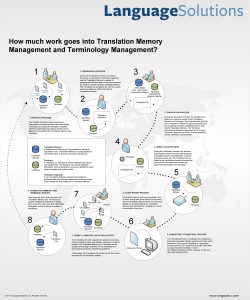
 Most standard translation technology solutions’ primary functionalities are preparing content for translation, storing previous translations, and creating translated documents. Depending on your needs and capabilities, you may want to invest in software or a subscription that you own. If that’s not the right choice for you, a well-rounded language service provider (LSP) like Language Solutions will maintain the translation technology solutions that ensure you get what you’re looking for with every project.
We’ve written about computer assisted translation (CAT) tools before, generally in the context of how we use them to help our clients. Some of the principal benefits of a good CAT tool are efficiency, consistency, and quality assurance. Using a CAT tool is not the same as machine translation or AI, though many CAT tools integrate these functions for translators who want to use them.
If you’re considering integrating translation technology solutions into your workflows, read on to learn more about what you should expect. We don’t want to frame these expectations as “pros and cons,” because everyone’s priorities and budgets are different. How you react to the following considerations may help you determine whether investing in translation technology solutions internally is the right choice for you.
Doing your research
There are dozens of CAT tools out there. Consider your starting point and how much time you’ll need to devote to researching and testing all the options available to you. Are you starting completely from scratch, or do you have some baseline knowledge of translation technology solutions? Do you know what an XLIFF is? What about segmentation rules? You may need to spend some time up-front getting to know how CAT tools and other translation technology solutions work before you feel prepared to decide which one(s) will best serve you and your company.
If you feel prepared to compare apples to apples, you’ll then need to come up with a list of must-haves, nice-to-haves, and deal-breakers. What file types will you need to translate? Trados Studio, the CAT tool we use, can handle at least 27 file types, including Microsoft Word, Excel, and PowerPoint, Adobe InDesign, HTML, JSON, and SRT. Do you want cloud capabilities, or local functionality only? Do your translators work in a certain CAT tool? Many programs are cross-compatible but not all of them are. If your go-to translation team(s) work with certain programs, we certainly recommend taking that into account.
A learning curve
It takes time to learn any new system or program. And becoming as efficient and effective as possible at using a new system takes additional time and effort. Many companies have either a full-time employee or even a team whose sole responsibility is to manage localization. If you don’t have that, is a member of your current staff prepared and able to take on learning a new system? Do they have the time and support to manage translation technology solutions in addition to their current workload? If not, does it make sense to hire someone new?
Investment
That brings us to the next expectation, which is that many translation technology solutions cost money. Do you want to pay a one-time licensing fee, or for a subscription? Are cloud capabilities and other functionalities built into the software, or treated as add-ons at an additional charge? Are there free tools out there that fulfill all your must-haves?
If you work with or are considering working with an LSP, you should also consider that investment. If your LSP uses robust translation technology solutions, is it worth it for you to do the same? If the answer is yes, are the tools you’re looking at compatible with the tool(s) your LSP uses? It’ll be important to do a cost-benefit analysis internally as well as in the context of your relationship with an LSP.
Ownership and version control
 For businesses outside the language services industry, acquiring translation technology solutions can be a double-edged sword. It puts you in full control of your assets and you have access to your translation memories and glossaries at any time, for any purpose. This can be beneficial in time-crunch situations when copy has been translated before. For example, one of our clients sent us updates to their New Hire handbook that needed to be applied to the Spanish version of the handbook in time for several new employees’ first day at work. When we prepared the updates in our CAT tool, we discovered that we had already translated all the “new” copy previously, as part of other assets (an employee newsletter, an open enrollment reminder postcard, etc.). We still had the translator check to make sure the translations were appropriate in the context of the handbook, but that was a much faster job than translating the updates “from scratch.” If our client had been able to search their own translation memory, that would have saved time and probably a lot of stress on their end!
On the other hand, owning your own translation technology solutions also gives you something else to keep track of. If you’re concerned about version control and don’t have the bandwidth to maintain an additional resource, a trusted LSP will manage these assets for you. We update each of our client’s translation memories after each translation project is finalized and do regular maintenance to ensure that outdated or superfluous translation units are modified, removed, or flagged.
What’s next?
If you’ve gotten to this point and are thinking “we have nothing to lose and everything to gain by doing more in-house,” then investing in translation technology solutions could be the right next step for you. If your reaction was more along the lines of “I don’t have the time, energy, or budget for all that,” then don’t worry – a good LSP will manage translation technology so you don’t have to. Our stance is that no matter how involved, or uninvolved, our clients want to be with translation technology solutions, the tangible assets like translation memories and termbases that we maintain truly belong to them. We’re big on client mentorship here at Language Solutions. If that sounds like something you’re after, please get in touch – we’re here to listen!
