
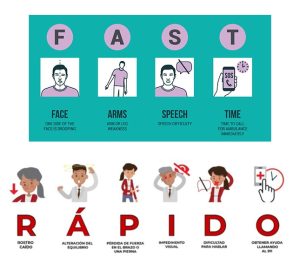
 In an exciting development for healthcare marketing translations, the American Stroke Association has officially adopted the RÁPIDO acronym for stroke detection! Even if you work in a subject area that has nothing to do with strokes, the exploration of this milestone can provide some insight into translating marketing materials in the healthcare sector. If you are creating a campaign that will be seen by a multilingual audience, perhaps the information we share will help you craft your English message to be more adaptable to other languages. If you already have assets that you’re thinking about translating, we hope to prepare you for any challenges that you might encounter during the process.
We’ve written about the RÁPIDO acronym before, in our post about common challenges in marketing translations and in our post about patient-friendly translation. Those posts were published almost two years apart, and this post is being written another two years later. What was going on during all that time, you may ask? In their original post about the development of the Spanish-language mnemonic, the developers of RÁPIDO, UTHealth Houston, indicated that it “need[ed] to be evaluated and confirmed as an effective tool from the broader medical community” and that only “[o]nce accepted” it could be included in educational campaigns. This is not something that is achieved in one focus group or at a single conference. If your healthcare marketing materials include mnemonic devices such as acronyms (like “FAST”), catchphrases (“Stop, Drop, and Roll,” for example), or rhymes (such as “Leaves of three, Let it be”), creating translated versions may not be as straightforward as you anticipated. Just as the source versions go through a rigorous development and testing process, the foreign language versions should be handled with the same care and may not be readily adopted right away.
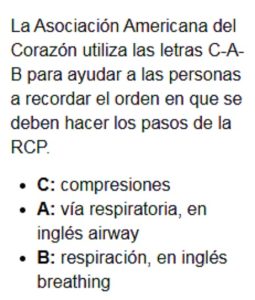 For example, the acronym CAB (Compressions, Airway, Breathing) that accompanies CPR training seems to have gotten a bit lost in Spanish language materials. Drugs.com has tried their hand at transcreation of the acronym, maintaining “C” for “compresiones” (compressions) but repurposing the “A” for “abrir las vías respiratorias” (open the airways) and the “B” for “respiración boca a boca” (mouth to mouth breathing). The Mayo Clinic, on the other hand, relies partially on the strategy that we have used in many of our healthcare marketing translations: maintain the English-language acronym, identify what each letter stands for in English, and provide a translation for each of these words or phrases. You can see a screenshot from the Mayo Clinic’s Spanish-language CPR webpage at right, where they have chosen not to identify the English for “compressions,” since the Spanish word also starts with “c.” When you look up the “RICE” acronym (Rest, Ice, Compression, Elevation) in Spanish, the first several results identify that the acronym is based on the English words and includes what those are, along with translations for each one. This presentation in this particular case may have something to do with the fact that most of the equivalent Spanish words start with the same letters (reposo, compresión, elevación). The word “rice,” however, is a conjugated form of the verb “rizar” in Spanish, so without proper field testing it’s hard to say how quickly the RICE protocol would come to mind for a Spanish speaker.
We recently worked on a patient education brochure that used the acronym CHAT to encourage patients to check in with their provider, ask about specific symptoms, and treat as directed. Since this acronym is not part of a larger public health initiative, we encouraged our translation team to get creative. They suggested charle con su proveedor, analice sus síntomas con su proveedor, and trate como se lo indicó el proveedor, which translates to “chat with your provider, discuss your symptoms with your provider, and treat as directed by your provider.” Since these healthcare marketing translations are for a US audience, the translation team deemed that the word CHAT will still be recognized and understood.
If you are creating or have created healthcare marketing materials with mnemonic devices, other linguistic devices, or copyrighted elements such as slogans or catchphrases, be aware that these may not carry smoothly over into translated versions. Depending on the information, the assets you are using, your audience, and your end goals, you will have to determine the level of investment you are willing to make into developing equivalent mnemonics, etc. in your target language(s).
